Case study · Live site
Glitchdeals
A UK Amazon price-drop tracker. Community-verified price anomalies, posted as they hit, each one carrying its full price history.
- What it is
- Amazon UK price-anomaly tracker
- Built by
- Arun Paul, Saggar Studio
- Year
- Core stack
- Next.js 16, TypeScript, Supabase, Clerk, Keepa API, Vercel
Summary
In short.
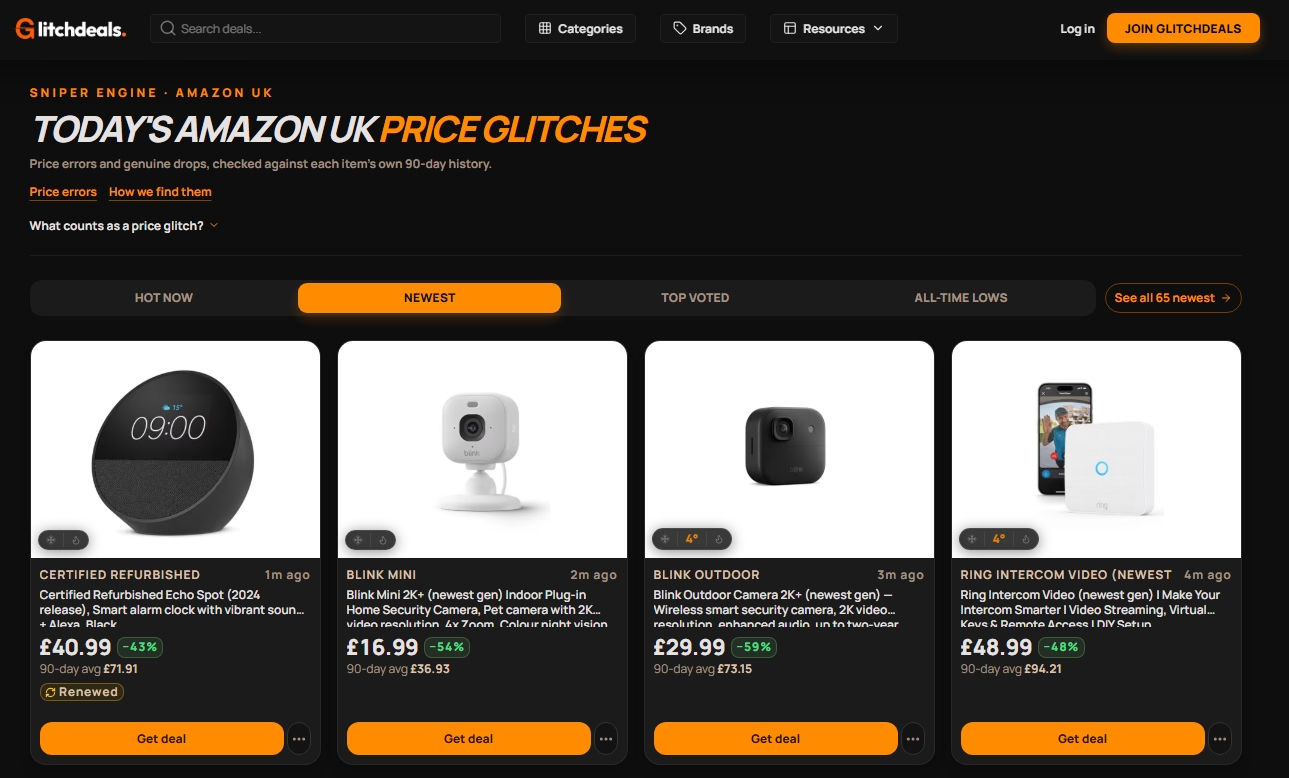
Glitchdeals (glitchdeals.co.uk) finds Amazon UK price errors and genuine price drops. A scheduled pipeline pulls deal data from the Keepa API, scores each deal from 0 to 100, and publishes it to a Next.js site.
Every deal card shows the current price, the size of the drop and the item's 90-day average, so a reader can judge the deal before clicking through.
The brief
The job.
A price glitch is only useful if you see it before it is fixed, and only believable if you can see what the item normally costs. The site had to do both: post anomalies as they happen, and put the price history next to every one.
What was built
Five parts that do the work.
A scored deal feed
A Keepa ETL job runs on pg_cron inside Supabase Postgres. It scores each deal from 0 to 100 and writes it to the feed, where readers sort by Hot now, Newest, Top voted or All-time lows.
Evidence on every card
Each card carries the price, the percentage drop and the 90-day average, plus a Renewed label where it applies. Product pages carry the full price history.
Community verification
Members vote on each anomaly and the Top voted view ranks them. Accounts run on Clerk with MFA and OAuth. Cloudflare Turnstile and Upstash rate limiting guard against automated abuse.
Built for the phone
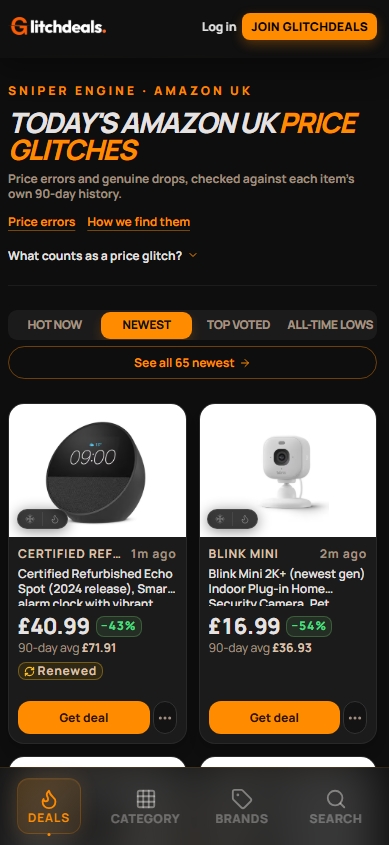
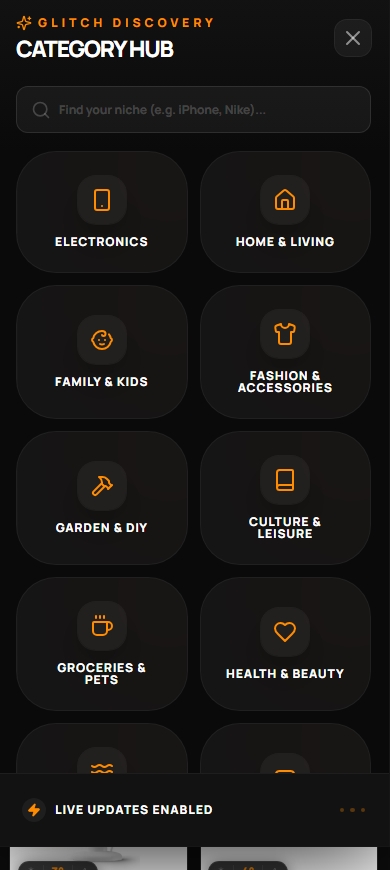
On mobile a fixed bottom bar puts Deals, Category, Brands and Search in thumb reach. Cards drop to two columns and keep the price, drop and average visible.
Data locked down at the database
35 tables sit behind 22 row-level security policies and around 70 Postgres functions. Sentry reports errors from client, server and edge, and GitHub Actions scans for leaked secrets with Gitleaks.
Mobile
The same feed, one-handed.
The deal feed and category browser on a phone. The bottom bar stays fixed while the feed scrolls.
By the numbers
The codebase.
- Lines of code
- 56,458
- Commits
- 184
- Database migrations
- 50
- Tables
- 35
- Postgres functions
- ~70
- Row-level security policies
- 22
- Components
- 103
- Tests
- 318
Figures from the engineering brief, . These describe the build, not traffic or revenue.
Stack
What it runs on.
| Framework | Next.js 16.1 App Router (React Server Components, ISR, server actions), React 18.3, TypeScript 5.9 strict |
|---|---|
| Styling and UI | Tailwind CSS 3.4 with CSS custom-property tokens, shadcn/ui conventions on Radix UI, Framer Motion 12, Manrope |
| State | Zustand 5 |
| Database | Supabase: Postgres, row-level security, Realtime, Storage, Edge Functions (Deno), Vault |
| Scheduling | pg_cron and PL/pgSQL |
| Cache and rate limits | Upstash Redis with @upstash/ratelimit |
| Accounts | Clerk 7 with MFA, OAuth and a custom domain |
| Data sources | Keepa API (deal, product, tracking, webhook), eBay Browse API. An Amazon affiliate integration is built and switched off. |
| Analytics and monitoring | PostHog with session replay, GA4, Microsoft Clarity, Sentry, Vercel Speed Insights |
| Security | Cloudflare Turnstile, Gitleaks, Web Crypto in edge middleware |
| Testing | Vitest 4 with v8 coverage, deno test, ESLint 9, tsc --noEmit |
| Hosting and CI | Vercel, GitHub Actions (secret scan, release, branch sync), Dependabot |
Questions
Straight answers.
What is Glitchdeals?
Glitchdeals is a UK website at glitchdeals.co.uk that tracks Amazon UK price errors and genuine price drops. Each deal is checked against the item's own 90-day price history.
How does Glitchdeals find price glitches?
A scheduled pipeline pulls deal and product data from the Keepa API, scores each deal from 0 to 100 and publishes it to the site. Members then vote on each anomaly.
What is Glitchdeals built with?
Next.js 16 and strict TypeScript on Vercel, Supabase Postgres for data and scheduling, Clerk for accounts, Upstash Redis for caching and rate limiting, and the Keepa API for Amazon price data.
Who built Glitchdeals?
Arun Paul, founder of Saggar Studio, a web studio based in Manchester and Stoke-on-Trent.